
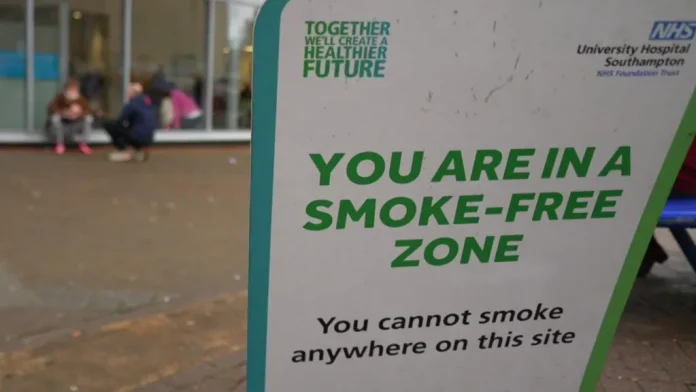
The smoking outside hospitals challenge persists across UK healthcare facilities. Source: BBC reporting from University Hospital Southampton and national hospital trust observations. Consequently, patients, visitors, and staff frequently light up near entrances. This occurs despite official smoke-free zone declarations.
Specifically, most hospital trusts declared themselves smoke-free. However, the reality differs significantly from policy. People smoke right outside hospital doors daily. Weather conditions rarely deter this behavior. Furthermore, enforcement remains inconsistent across sites.
Jane Gibbs, 72, defended her choice to smoke outside University Hospital Southampton. She accompanied her daughter to an appointment that day. Gibbs questioned the logic of restricting cigarettes near car exhaust fumes. “When they stop [the cars] then maybe I’ll think twice,” she stated. Additionally, she emphasized personal responsibility. Gibbs would never smoke indoors or near children. She asks permission before lighting up near others.
Grant Middleton, in his 50s, started smoking around age 10. He expressed no plans to quit. Middleton noted people tolerate smoking outside hospitals. “If people came out and said ‘we’ll not tolerate it’, you wouldn’t smoke,” he explained. Consequently, tolerance enables continued behavior. He would comply if enforcement increased.
Inpatient Anthony Nichol smoked beside the front door during our conversation. He acknowledged smoke-free signs but questioned freedom restrictions. “I think we are losing a lot of our freedoms,” Nichol stated. Furthermore, he wondered about future restrictions. He would abide by new laws to avoid fines or removal.
Chief medical officer Paul Grundy recognized these complexities. “It is an addiction – they’re here, often at the most stressful time in their lives,” Grundy explained. Additionally, he noted mobility challenges for some patients. Walking 20-30 meters to site edges proves difficult for less mobile individuals. Therefore, the trust developed a dedicated smoke-free strategy. A quarterly tobacco dependency steering group monitors progress.
The smoking outside hospitals issue reflects broader public health tensions. Smoke-free policies aim to protect vulnerable populations. However, addiction complicates enforcement efforts. Moreover, personal freedom arguments challenge restriction measures. Consequently, healthcare leaders seek balanced solutions.
Parliament currently considers a Tobacco and Vapes Bill. This legislation aims to outlaw smoking in multiple locations. Hospitals represent one targeted setting. A public consultation remains open until May. Furthermore, any new rules include a six-month implementation period. Therefore, policy changes may soon affect current practices.
Hospital trusts implement varied approaches to address smoking outside hospitals. Some provide designated smoking areas at site perimeters. Others offer nicotine replacement therapies to inpatients. Additionally, staff training improves compassionate enforcement. These strategies acknowledge addiction while protecting public health.
Public opinion on smoking outside hospitals remains divided. Some support strict enforcement to protect non-smokers. Others prioritize personal choice in outdoor spaces. Notably, secondhand smoke risks decrease significantly outdoors. However, visual normalization of smoking concerns health advocates. Therefore, messaging strategies emphasize health impacts without stigma.
The smoking outside hospitals challenge requires multi-faceted solutions. First, clear communication about policy reasons builds understanding. Second, support services help smokers manage cravings during visits. Third, consistent enforcement establishes clear expectations. Finally, ongoing evaluation improves intervention effectiveness. Consequently, trusts can balance compassion with public health goals.
Staff experiences further illuminate this complex issue. Healthcare workers witness patients struggling with addiction during stressful times. Therefore, many advocate for supportive rather than punitive approaches. Additionally, staff smokers face similar restrictions during breaks. Consequently, workplace support programs benefit both employees and patients.
Environmental considerations also influence this debate. Cigarette litter creates maintenance challenges for hospital grounds. Furthermore, butts pose fire risks near oxygen storage areas. Therefore, proper disposal infrastructure supports smoke-free goals. Additionally, clean grounds enhance healing environments for all visitors.
The smoking outside hospitals discussion extends beyond individual choices. It reflects societal approaches to addiction management. Public health strategies increasingly emphasize harm reduction. Consequently, policies balance restriction with support services. This approach acknowledges complexity while pursuing healthier outcomes.
As policy evolves, stakeholder engagement remains crucial. Patients, visitors, staff, and communities all hold valuable perspectives. Therefore, inclusive consultation processes improve policy acceptance. Moreover, transparent communication about health rationales builds trust. Consequently, collaborative solutions achieve better long-term results.
Ultimately, addressing smoking outside hospitals requires sustained commitment. Policy changes alone cannot resolve deeply rooted behaviors. Therefore, combining clear rules with compassionate support offers the best path forward. Protecting public health while respecting individual dignity remains the shared goal. Consequently, ongoing dialogue and adaptation will shape effective solutions.
READ: Africa CDC FHI 360 Partnership Strengthens Health Security

