
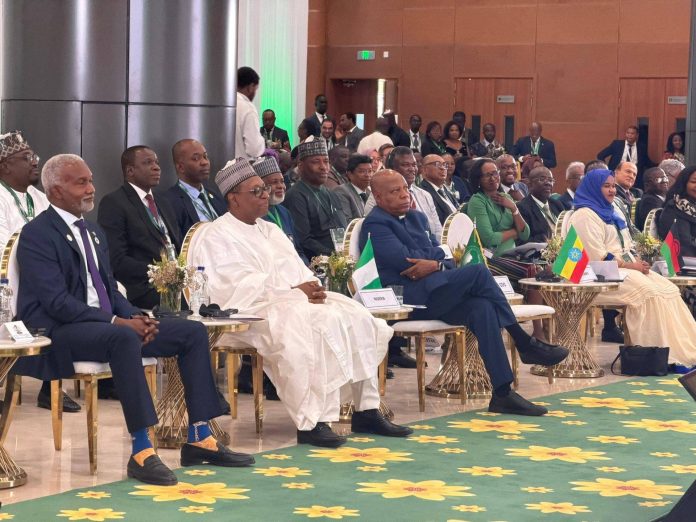
Nigeria is calling for a continent-wide shift toward health security sovereignty in Africa. Specifically, the goal is to replace dependence on foreign aid with resilient, homegrown health systems. To this end, Vice President Kashim Shettima delivered a strong message during a high-level side event at the 39th African Union Assembly in Addis Ababa, Ethiopia.
He stressed that Africa must no longer tie its health outcomes to distant supply chains or the shifting priorities of global donors. Indeed, he declared, “Health security is national security.” Moreover, he added, “In an interconnected continent, national security is continental security.”
The initiative stems from a collaboration between the Nigerian government and the Africa Centre for Disease Control and Prevention (Africa CDC). Consequently, it aims to mobilize investment in three key areas: the health workforce, community health programs, and sustainable immunization systems.
Vice President Shettima reaffirmed Nigeria’s readiness to partner with all African nations. Furthermore, he outlined concrete measures of success: factories commissioned, laboratories accredited, health workers trained, counterfeit drug markets dismantled, and insurance coverage expanded. “When history reflects on this generation,” he said, “may it record that we chose capacity over vulnerability, dignity over dependence, and cooperation over isolation.”
He recalled how Africa struggled during the COVID-19 pandemic. At that time, while the world turned inward, African nations waited for rationed vaccines and scarce oxygen. Although endurance carries dignity, he noted, it is not a strategy. Therefore, true leadership lies in deliberately reducing vulnerability.
To that end, Nigeria is taking decisive action under President Bola Tinubu’s administration. For instance, the country is boosting local pharmaceutical manufacturing. In addition, it is increasing domestic health financing and strengthening regulatory oversight. Key programs include the Nigeria Health Sector Renewal Investment Initiative and the Presidential Initiative to Unlock the Healthcare Value Chain (PIPUHVAC).
Time is critical in public health, the Vice President emphasized. Thus, Nigeria is enhancing laboratory networks. Likewise, it is expanding genomic surveillance and reinforcing emergency coordination through the Nigeria Centre for Disease Control and Prevention (NCDC). As a result, the nation has already improved its response to global disease outbreaks.
Beyond infrastructure, Nigeria is also building human capital. Professor Muhammad Pate, Minister of Health and Social Welfare, highlighted ongoing efforts. Specifically, the government is creating a reliable health workforce database. Additionally, it is training professionals to handle complex emergencies and addressing the rural-urban imbalance in health worker distribution.
Dr. Jean Kaseya, Director General of Africa CDC, praised Nigeria’s leadership. In particular, he commended its healthcare reforms in epidemic resilience and immunization. Meanwhile, health ministers from Senegal, Malawi, and Ethiopia voiced strong support. Accordingly, they pledged to align their national strategies with this vision and invest in community-level health systems.
In sum, Nigeria’s push for health security sovereignty marks a turning point. Ultimately, it is not just about producing medicines locally—it is about building a continent that can heal itself, together.
READ: British-Built Wearable Aims to Transform Dengue Fever Care in Vietnam

