
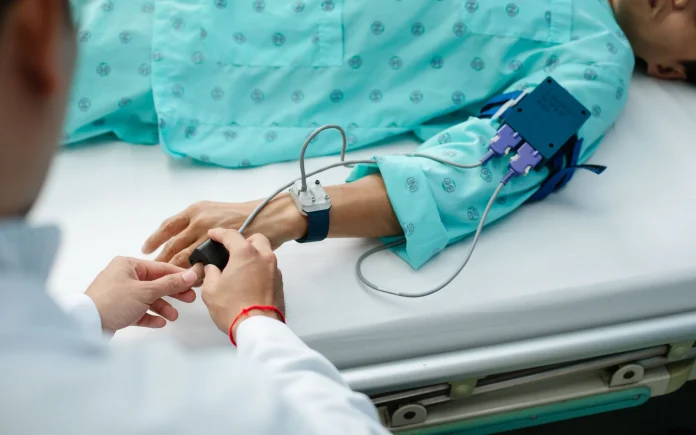
A groundbreaking dengue fever wearable developed by British engineers is now in clinical trials in Vietnam. Moreover, it could greatly improve how the disease is managed in high-risk areas. The device is called D-Scape—short for Dengue Shock and Classification Prediction Wearable.
D-Scape includes a wristband that looks like a smartwatch and a small sensor clipped to the little finger. Together, they monitor vital signs without needles or discomfort. On-board AI algorithms then analyze this data in real time. As a result, doctors can spot patients likely to develop severe dengue much earlier.
Early detection is critical because dengue often worsens suddenly after the fever breaks. In fact, many patients appear to recover—only to decline rapidly within hours. Therefore, timely intervention can mean the difference between life and death.
While dengue remains rare in Europe and North America, it affects nearly half the world’s population. Specifically, it spreads through Aedes mosquitoes in tropical and subtropical regions. Consequently, these areas face recurring outbreaks each year. Annually, the virus causes between 100 and 400 million infections.
Most people experience only mild, flu-like symptoms and recover on their own. However, some develop a severe form known as “break-bone fever.” In extreme cases, it behaves like haemorrhagic fevers such as Ebola. Plasma leaks from blood vessels, which can lead to organ damage and uncontrolled bleeding. Tragically, about 9,500 people died from these complications in 2024 alone.
The biggest challenge lies in predicting who will deteriorate. Dr. Ho Quang Chanh leads the Dengue Research Group at Oxford University’s clinical unit in Ho Chi Minh City. He helped oversee the D-Scape trial.
“We have many infected patients,” he explained. “But we don’t know who will progress to severe disease.” This uncertainty creates major strain on hospitals every dengue season. Accordingly, staff must check vital signs every three to four hours. In critical cases, they check hourly—often working through sleepless night shifts.
Currently, medical teams rely on manual exams and repeated blood tests. D-Scape offers a better alternative. It provides continuous, automated monitoring. Thus, it significantly reduces the burden on overworked healthcare workers.
The device tracks subtle changes in heart rate, temperature, and blood flow. These signals can warn of deterioration before it becomes life-threatening. For example, early signs of plasma leakage may trigger an alert. As a result, clinicians can start fluid therapy sooner—greatly improving survival chances.
Furthermore, D-Scape may prevent unnecessary hospital admissions. Low-risk patients could be safely monitored at home. This would free up beds during peak outbreaks, easing pressure on emergency wards.
The Vietnam trial is testing the wearable in real-world conditions where dengue is endemic. If results are positive, the dengue fever wearable could expand to other affected regions across Asia, Latin America, and Africa.
Backed by engineering innovation and clinical insight, D-Scape represents a new era in preventive care. Ultimately, it turns passive observation into proactive, life-saving protection for millions at risk.
READ: 6 Science-Backed Reasons to Eat Oats Every Winter Morning

