
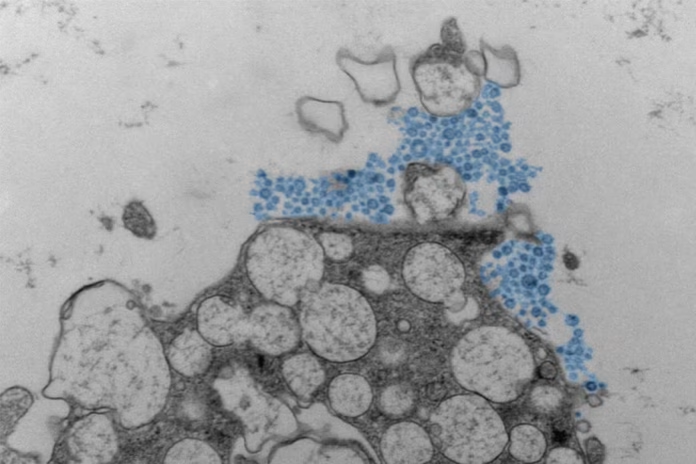
When Dr. Ellen Foxman watched her young son struggle to breathe during a severe asthma attack, the moment stayed with her. As both a parent and a scientist, the experience raised a pressing question about why common viral infections affect people so differently. That question has now led to new insights into the link between rhinovirus asthma and immune response.
Foxman, an associate professor of laboratory medicine and immunobiology at Yale School of Medicine, knew that her son had asthma. She also knew that rhinovirus, the most common cause of the common cold, is the leading trigger of asthma attacks. What remained unclear was why the same virus causes life-threatening breathing problems in some people while barely causing symptoms in others.
Rhinovirus infections are remarkably common, yet their outcomes vary widely. Many people experience only mild nasal symptoms. However, in people with asthma, the virus can provoke dangerous airway inflammation. Understanding that difference has been a longstanding challenge in respiratory medicine.
Rhinovirus Asthma and the Body’s First Line of Defense
Foxman and her colleagues discovered that the key factor lies in how quickly nasal cells respond to the virus. Their study, published in January in the journal Cell Press Blue, shows that the early immune reaction in the nose plays a decisive role.
The researchers focused on interferons, proteins that help cells limit viral spread. When nasal cells mount a rapid interferon response, the virus remains tightly contained. According to Foxman, this response can prevent the infection from spreading beyond a tiny fraction of cells.
In contrast, when the interferon response is delayed or blocked, the virus spreads more widely. This leads to excessive mucus production and inflammation, which are hallmarks of severe colds and asthma attacks. As Foxman explained, it is often the body’s reaction, not the virus itself, that determines disease severity.
How Scientists Recreated Infection in the Lab
To reach these conclusions, the Yale team grew nasal cells from healthy adults in a laboratory. Over four weeks, the cells developed into complex tissues resembling the lining of the human nose. This approach allowed researchers to study viral infection in a controlled but realistic environment.
Once the tissues matured, the scientists exposed them to rhinovirus. Using advanced imaging techniques, they observed how thousands of cells reacted at once. They tracked both infected cells and nearby bystander cells to see how immune defenses were activated.
When the interferon response was fast, fewer than 2% of cells became infected. In real life, this could translate into mild symptoms or no symptoms at all. However, when researchers suppressed the interferon response, infection spread to roughly 30% of cells. In those cases, mucus and inflammation increased sharply.
Why Some People Get Severe Symptoms
These findings help explain why rhinovirus asthma attacks can be so severe for some individuals. A weakened early immune response allows the virus to gain a foothold, triggering inflammation that narrows airways and worsens breathing.
Still, an important question remains unanswered. Scientists do not yet know why some people have a weaker interferon response than others. Foxman noted that further research in real-life patients will be needed to identify the underlying causes.
Possible explanations include genetic differences, existing airway inflammation, or interactions with other microbes in the nose. Each of these factors could influence how the immune system responds when rhinovirus strikes.
Read Also
The Mystery of Migraines
Intrusive Thoughts
How Fibre Boosts Health
Implications for Future Treatments
Foxman describes the study as an early step toward better treatments. Rather than targeting the virus directly, future therapies might focus on controlling inflammation and mucus production. By strengthening or mimicking the interferon response, doctors may be able to reduce the severity of rhinovirus asthma attacks.
Dr. Dan Barouch, director of the Center for Virology and Vaccine Research at Beth Israel Deaconess Medical Center, called the findings informative. However, he emphasized that lab results must be confirmed in real patients. While interferon appears central, other immune pathways may also contribute.
Barouch noted that people with a strong initial interferon response may clear the virus quickly, while others experience prolonged illness. Even so, it remains unclear how individuals can safely boost this response on their own.
A Broader Pattern in Viral Illness
The question of why the same virus affects people differently extends beyond rhinovirus asthma. Dr. Larry Anderson, a professor of pediatric infectious diseases at Emory University, said this pattern appears across many respiratory infections.
Influenza, respiratory syncytial virus, parainfluenza virus, and coronavirus all show similar variability. Factors such as genetics, underlying health conditions, prior immunity, and the presence of bacteria can all shape outcomes.
As researchers continue to explore these interactions, studies like Foxman’s provide crucial clues. By focusing on the earliest immune responses, scientists are gaining a clearer picture of how common viruses trigger severe disease in vulnerable people. That knowledge may eventually lead to more precise and effective ways to protect those at highest risk.

