
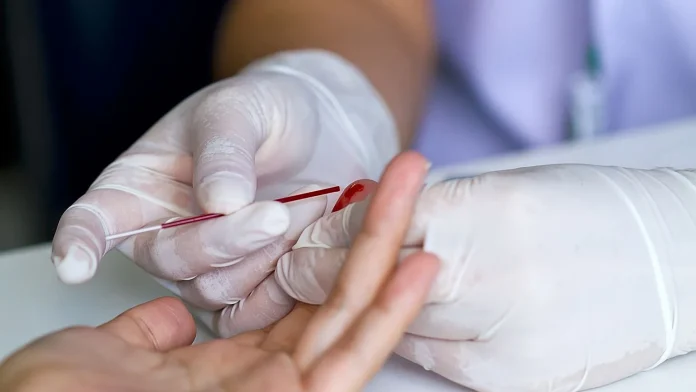
One day, detecting early Alzheimer’s could be as simple as a finger prick. A new study in Nature Medicine shows an Alzheimer’s finger-prick blood test can reliably measure key biomarkers from dried blood spots.
The test detects p-tau217, GFAP, and NfL—proteins linked to Alzheimer’s brain changes. Results closely match those from standard venous blood draws. This makes the method promising for wider use.
Researchers led by Nicholas Ashton at the University of Gothenburg analyzed 337 samples across seven European sites. They found strong correlation between dried-spot and plasma p-tau217 levels (r = 0.74). GFAP and NfL also aligned well.
Moreover, the Alzheimer’s finger-prick blood test predicted abnormal cerebrospinal fluid (CSF) biomarkers with 86% accuracy. Standard blood tests achieve 98%. So while slightly less precise, the finger-prick method still offers strong diagnostic potential.
Importantly, it works without complex logistics. Traditional blood tests need trained staff, centrifuges, freezers, and cold shipping. In contrast, dried spots dry on cards and mail at room temperature.
“This could reveal true Alzheimer’s prevalence in remote areas,” said co-author Henrik Zetterberg. He cited regions like rural Africa or Southeast Asia where venous draws are hard to perform.
As a result, the approach is ideal for research and clinical trials. For example, companies could pair finger-prick cards with smartphone cognitive tests. This would allow remote screening and cut trial screen-failure rates dramatically.
However, experts warn it’s not ready for clinics yet. About 15–25% of collections failed due to poor technique. Squeezing the finger dilutes blood with tissue fluid—which degrades biomarkers. Therefore, proper training is essential.
Researchers are already testing better tools. Devices like Tasso Inc.’s upper-arm lancet may simplify sampling. New platforms such as Alamar’s NULISA could soon measure over 100 biomarkers from one spot.
The study also included 31 people with Down’s syndrome—a high-risk group. Dried-spot p-tau217 and GFAP performed well here too. This highlights value for populations where venipuncture is difficult.
Still, scientists agree: this test belongs in research for now. “Standard plasma tests are more accurate and increasingly available in clinics,” said Kellen Petersen of Washington University. “Dried spots will help trials and remote studies—not replace doctor visits.”
Looking ahead, teams must refine collection methods and validate home use. If they succeed, this simple drop of blood could expand early detection worldwide—without needles, freezers, or barriers.
READ: Ugandan Man Cured of Sickle Cell Disease via Gene Therapy

