
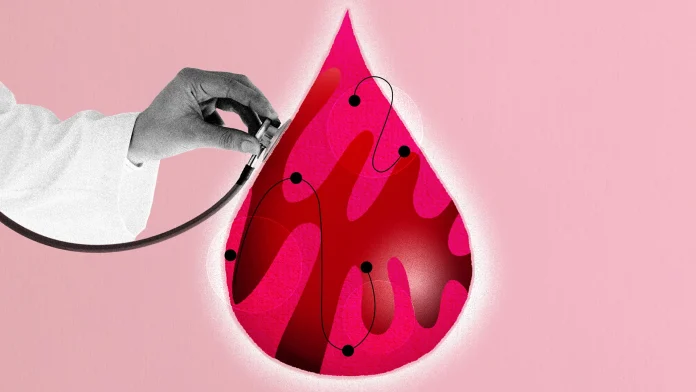
Period blood research is gaining momentum as scientists uncover how menstrual samples may reveal crucial insights into women’s health. Researchers now believe menstrual blood could help diagnose diseases earlier and provide a clearer picture of reproductive health.
For decades, medical science largely overlooked menstrual blood as a diagnostic tool. However, new studies suggest the biological material may hold valuable medical clues.
Biotech companies and academic researchers are now analyzing menstrual samples to study conditions such as endometriosis, cervical cancer, diabetes risk, vitamin deficiencies, and environmental exposure.
By examining these samples, scientists hope to develop diagnostic tests that are faster, cheaper, and less invasive than current medical procedures.
Period blood research offers new diagnostic potential
Interest in period blood research is partly driven by the limitations of existing diagnostic methods.
For example, diagnosing endometriosis often requires laparoscopy. This procedure involves inserting a small camera into the pelvic cavity to confirm the condition.
The process can take years to reach. Many women wait between five and twelve years before receiving a proper diagnosis.
Endometriosis affects around 190 million people worldwide. The condition causes severe pelvic pain, heavy periods, digestive problems, and sometimes infertility.
Emma Backlund, a graduate student from Minnesota, experienced those challenges firsthand. She suffered intense menstrual pain for years before doctors finally diagnosed her with endometriosis.
Backlund eventually contributed to period blood research by sending menstrual samples to a biotechnology company studying the disease.
Her experience highlights the urgent need for faster diagnostic tools.
Period blood research explores unique biological signals
Scientists say menstrual blood is a complex biological fluid with unique properties.
Approximately half of menstrual blood consists of ordinary blood. The remainder contains hormones, proteins, bacteria, and tissue cells from reproductive organs.
These cells originate from the uterus, cervix, ovaries, fallopian tubes, and vaginal lining.
Because of this mixture, menstrual blood provides information that traditional blood tests cannot capture.
Ridhi Tariyal, cofounder of biotech startup NextGen Jane, describes menstrual blood as a natural biopsy of reproductive organs.
Her company sends specially designed tampons to volunteers who collect samples at home.
Researchers then analyze the samples to identify molecular signals associated with disease.
Since its founding in 2014, the company has studied more than 2,000 menstrual samples collected from over 330 women.
Read Also
FDA Rejects Moderna mRNA Flu Vaccine Application
Investigation Finds Contaminants in Popular Dog Foods
Period blood research seeks endometriosis biomarkers
A major goal of period blood research is identifying biomarkers linked to endometriosis.
Biomarkers are measurable biological indicators that help doctors detect diseases.
Christine Metz, a reproductive biologist at the Feinstein Institutes for Medical Research, has studied menstrual samples for more than a decade.
Her research focuses on identifying biological differences between healthy individuals and those diagnosed with endometriosis.
Studies have revealed several promising patterns.
Women with endometriosis often have lower levels of uterine natural killer cells. These immune cells play a key role in embryo implantation and infection protection.
Researchers also observed changes in stromal fibroblast cells, which normally help repair the uterine lining after each menstrual cycle.
In patients with endometriosis, these cells show higher inflammatory signals and reduced ability to support pregnancy.
Additionally, scientists discovered changes in gene expression within menstrual samples from affected patients.
These biological differences could form the basis for a non-invasive diagnostic test.
Metz hopes to apply for approval from the U.S. Food and Drug Administration for a home-based diagnostic kit by 2027.
Period blood research expands beyond reproductive diseases
Although endometriosis remains a major focus, scientists believe period blood research could reveal insights into many other conditions.
Researchers are investigating links between menstrual samples and hormone changes associated with aging.
Early evidence suggests that shifts in estrogen levels may be visible in menstrual blood long before symptoms appear.
Scientists are also exploring whether menstrual samples can help detect immune-related conditions.
Some studies suggest menstrual blood may reveal markers associated with thyroid disorders such as hypothyroidism or hyperthyroidism.
These diseases affect hormone production in the thyroid gland and can influence metabolism throughout the body.
Researchers also suspect menstrual blood may provide insights into inflammatory and autoimmune diseases.
Period blood research could reshape medical science
Beyond diagnostics, period blood research may offer new ways to study how the body responds to inflammation and healing.
During the menstrual cycle, the body repeatedly transitions between inflammation and tissue repair.
Scientists believe this process could provide a valuable model for understanding diseases such as rheumatoid arthritis, lupus, and multiple sclerosis.
By studying menstrual blood, researchers may uncover mechanisms behind these complex conditions.
The field remains in its early stages, but interest is growing rapidly.
As new technologies enable deeper genetic and molecular analysis, menstrual blood may become a powerful tool for improving women’s healthcare.
Researchers believe this overlooked biological resource could transform how doctors diagnose diseases, monitor reproductive health, and understand the female body.

