
Mental Health Crisis West Nile is emerging as one of the most urgent social challenges facing young people in northern Uganda, as unemployment, academic pressure and social expectations weigh heavily on the region’s youth. In Arua City, stories like that of Frank – a university graduate whose name has been changed to protect his identity – illustrate a growing and largely invisible struggle affecting thousands of young people across the West Nile sub-region.
At 33, Frank once appeared to live a normal life. He attended university, socialised with friends and believed his future would unfold like that of many ambitious young Ugandans. His family viewed him as hardworking and determined, a student destined to succeed. Beneath that appearance, however, he fought a silent battle with anxiety, exhaustion and self-doubt. Each morning began with overwhelming fatigue despite adequate sleep. Simple tasks such as attending lectures, responding to messages or preparing for exams felt mentally draining. Constant worries about grades, family expectations and the uncertainty of employment after graduation gradually consumed his thoughts.
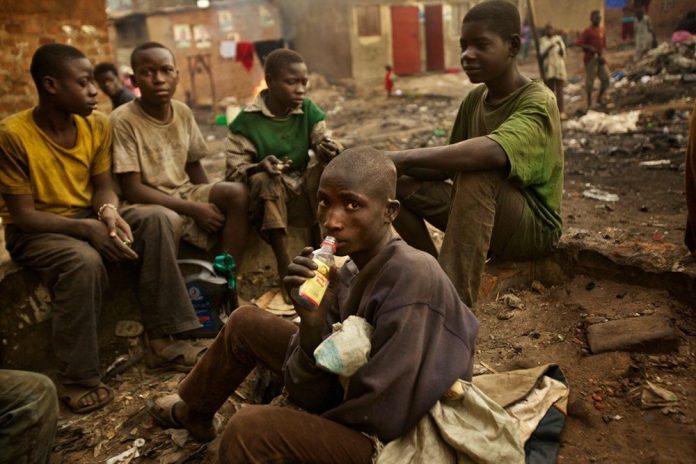
Across the region, Frank’s experience reflects the broader Mental Health Crisis West Nile communities are now confronting. In towns and trading centres across the sub-region, increasing numbers of people suspected to be experiencing mental illness, addiction or emotional distress can be seen wandering streets, sleeping near garbage collection points or seeking food outside restaurants and hotels. Many of them chew mairungi (khat), smoke drugs openly or rely heavily on alcohol. While older generations in West Nile struggled mainly with poverty, conflict or physical survival, the current generation is increasingly confronting a psychological burden that is less visible but equally damaging.
One of the main drivers behind the Mental Health Crisis West Nile is academic and career pressure. From childhood, many young Ugandans are taught that education represents the only reliable path to success. Families invest significant resources in school fees and encourage their children to pursue university degrees with the expectation that higher education guarantees employment. Yet as graduation approaches, reality often contradicts those expectations. Jobs in government institutions remain scarce and competition for available opportunities is extremely high. Many graduates therefore face prolonged unemployment, creating feelings of failure and disillusionment.
Frank experienced this pressure intensely. Every time he heard stories about university graduates remaining unemployed for years, his anxiety increased. Instead of viewing education as a gateway to opportunity, he began to see it as a looming test that could determine whether he succeeded or disappointed those who believed in him. Questions constantly ran through his mind: What if I fail? What if I disappoint my family? What if my future collapses? Over time, these thoughts replaced optimism with fear and eroded his sense of confidence.
Social media has also intensified the Mental Health Crisis West Nile among youth. Platforms such as TikTok, Facebook, WhatsApp and X often present curated images of success – young entrepreneurs launching businesses, peers securing scholarships abroad, luxury lifestyles and early career achievements. For many young people struggling to find their footing, these images create unrealistic expectations. Instead of inspiration, constant comparison often triggers feelings of inadequacy.
Frank spent hours scrolling through social media hoping to find motivation. Instead, he saw former classmates celebrating achievements that seemed far beyond his reach. Each success story deepened his sense of falling behind. Even when he made small personal progress, he struggled to acknowledge it. Birthdays, social gatherings and celebrations gradually disappeared from his life as he focused only on perceived shortcomings. Eventually he withdrew from friends and family, and his emotional health deteriorated further.
The consequences of the Mental Health Crisis West Nile extend beyond emotional distress. Many affected young people begin to experience physical symptoms including insomnia, appetite loss and chronic fatigue. Others turn to alcohol or drugs in an attempt to cope with psychological pain. In extreme cases, academic performance declines sharply or students abandon education altogether.
Another story illustrates the depth of the problem. Mr Job Asiku, 30, has also struggled with severe mental health challenges. His friend Mr Levy Adaku, who grew up with him in Vurra in Arua District, explained that financial hardship played a major role. School fees, daily expenses and family responsibilities placed enormous pressure on Asiku while he attempted to continue his studies. The constant struggle to meet basic needs weakened his emotional resilience.
According to Adaku, exhaustion slowly turned into emotional numbness. Asiku began feeling disconnected from society and viewed himself as a failure. Friends occasionally help him with meals, but he sometimes disappears from Arua City for months at a time. His experience highlights how financial insecurity can deepen the Mental Health Crisis West Nile, especially in regions where employment opportunities remain limited.
Data from the Uganda Bureau of Statistics further illustrates the magnitude of the challenge. The 2024 census report estimates youth unemployment across the 13 districts of West Nile at approximately 64 percent. With a population of nearly 3.9 million people, the region faces significant economic pressure that directly affects the mental wellbeing of its young population.
Family expectations also contribute significantly to the Mental Health Crisis West Nile. Many parents make enormous sacrifices to educate their children and naturally hope those investments will translate into stability and success. While these expectations often stem from love and support, they can also create intense psychological pressure. Young people frequently feel responsible not only for their own future but also for lifting their families out of poverty.
Frank felt this responsibility acutely. He feared failing not just himself but everyone who had supported him. Instead of sharing his struggles, he chose silence, believing that admitting weakness might confirm his fears of disappointment. Such silence remains common in many communities where discussing mental health challenges is still considered taboo.
Cultural attitudes also complicate the Mental Health Crisis West Nile. In several communities, mental illness is often interpreted as a curse, spiritual punishment or personal weakness rather than a medical condition requiring professional support. Individuals experiencing mental health problems may therefore face stigma, abandonment or social isolation.
Residents in Arua City recall the case of a woman who has lived on the streets for decades. Known locally by the nickname “Oku’ika,” she survives largely on food leftovers or discarded waste. According to local resident Ms Selsa Adiru, only a few compassionate individuals occasionally provide meals. For many residents, the woman represents a long-standing symbol of how mental illness can lead to social exclusion.
Civil society organisations are now calling for stronger intervention to address the Mental Health Crisis West Nile. Mr Daniel Dratibi, director of Voice of Restoration International in West Nile, has urged leaders to prioritise mental health and psychosocial support programmes for youth. He argues that substance abuse, particularly alcohol and drugs, has contributed significantly to the rise of mental illness across towns and trading centres.
Dratibi notes that many organisations working on prevention and treatment lack sufficient funding, limiting their ability to reach vulnerable communities. He also emphasises the link between economic hardship and psychological distress, arguing that financial stability and mental health often reinforce one another. Without addressing unemployment and substance abuse simultaneously, the crisis may continue to deepen.
Community members are also advocating for stronger family and social support networks. Ms Jascinta Acikani, a parent from Kango Sub-county in Zombo District, believes young people must learn healthy coping strategies including balancing work and rest, building supportive friendships and seeking help during difficult times. She emphasises that success rarely follows a straight path and that setbacks should not be viewed as permanent failure.
The statistics reflect the seriousness of the Mental Health Crisis West Nile. Recorded mental health cases in the region have fluctuated but remain high, with 46,177 cases reported in 2021, 39,601 in 2022, 63,774 in 2023 and 62,340 in 2024. These figures suggest that while awareness is growing, the underlying drivers of psychological distress remain unresolved.
As West Nile continues to confront economic uncertainty, youth unemployment and social pressure, the mental wellbeing of its young population has become a defining public health issue. Stories like Frank’s reveal how easily hope can transform into anxiety when expectations collide with harsh economic realities. Without stronger community awareness, accessible mental health services and meaningful employment opportunities, the Mental Health Crisis West Nile may continue to shape the future of an entire generation.

