
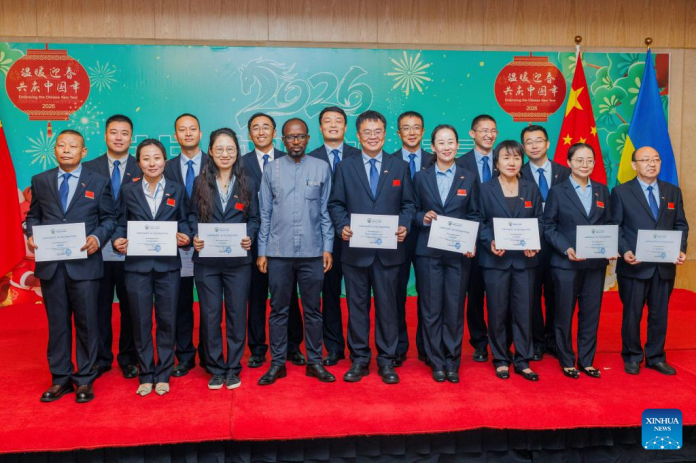
A handover ceremony in Kigali on Thursday night marked the arrival of the 26th Chinese medical team in Rwanda—and the departure of the 25th team—highlighting over four decades of sustained health collaboration between the two nations. The event underscored how this partnership has evolved from basic care to specialized, sustainable healthcare development.
Rwanda’s Ministry of Health Permanent Secretary, Ndayizigiye Jean Marie Vianney, opened the ceremony with heartfelt praise. “Whether in hospitals, clinics, or communities, your work embodies resilience, excellence, and selflessness,” he said. “Your service does not go unnoticed.” He added that the Chinese medical team in Rwanda reflects a deepening bilateral bond, one that brings not just treatment, but lasting skills, knowledge exchange, and stronger health systems.
Chinese Ambassador Gao Wenqi echoed this sentiment. He called the medical teams “a powerful testament to the deep bonds between our peoples.” Notably, this year’s delegation is larger and more specialized than before—signaling a new phase in cooperation. “We are elevating our health partnership to new heights,” he said.
Wang Yongxiang, head of the outgoing 25th team, shared key achievements from the past year. His team worked side by side with Rwandan colleagues in operating rooms, wards, and clinics. Together, they built an orthopedic specialty system and launched a standardized pain management clinic at Kibungo Hospital. They also trained local doctors in techniques like traditional Chinese acupuncture, painless labor, and infection control—ensuring these benefits continue long after they leave.
One standout figure received special recognition: Dr. Li Junsheng, honored by Rwanda’s Ministry of Health for 11 years of dedicated service across multiple missions. His commitment symbolizes the personal and professional investment Chinese medics make in Rwanda’s well-being.
Now, the 26th team steps in. Led by Han Hongyang, it includes 19 members spanning eight specialties: surgery, orthopedics, anaesthesia, obstetrics and gynaecology, nursing, and traditional Chinese medicine. Since 1982, China has sent 26 such teams to Rwanda, consistently providing daily care at Masaka Hospital and Kibungo Hospital.
This continuity matters. Unlike short-term aid, these rotations build institutional memory, trust, and capacity. As a result, Rwandan healthcare workers gain not just tools—but long-term partnerships that save lives and strengthen communities.
For both nations, the Chinese medical team in Rwanda is more than diplomacy—it’s a living bridge of care, skill, and shared humanity. And as the 26th team begins its mission, that bridge grows stronger still.
READ: Gates Foundation and OpenAI Launch $50M AI Health Initiative for Africa

