
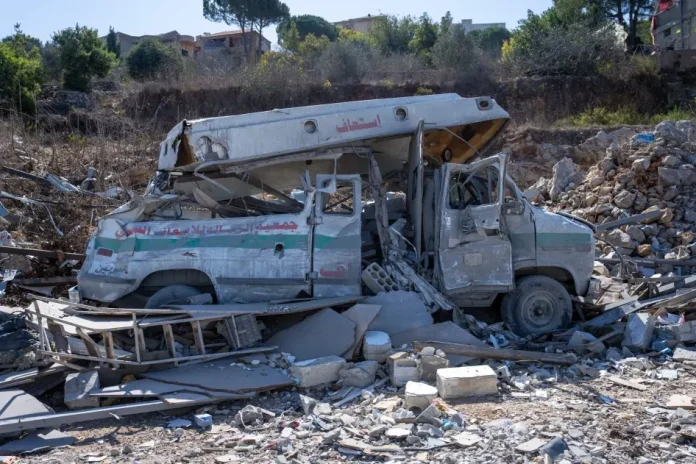
Lebanon war medics targeted has become a growing concern as healthcare workers report repeated strikes on ambulances and medical facilities in south Lebanon. Doctors, paramedics, and officials say these attacks form part of a broader pattern that is making daily life increasingly dangerous and unsustainable.
Since fighting escalated on 2 March, Israeli forces have struck at least 128 medical facilities and ambulances across the region. According to the Lebanese ministry of health, these attacks have killed 40 healthcare workers and injured 107 others. The conflict began after Hezbollah launched rockets into Israel, prompting a military response that has since expanded across southern Lebanon.
Many of the incidents occurred while medics carried out emergency work. Several healthcare workers reported that strikes hit ambulances or first aid centres while they were actively responding to wounded civilians. In multiple cases, facilities that provided essential services now lie in ruins, leaving communities without urgent care.
Witnesses also described the use of what appears to be double-tap strikes. This tactic involves an initial airstrike, followed by a pause that allows rescuers to arrive. A second strike then hits the same location. Medical workers say they have seen this pattern in several towns, where paramedics rushed in to help only to come under fire moments later .
International law protects medical workers and facilities during armed conflict. Targeting them may amount to a war crime. Human rights organisations stress that all medical personnel, regardless of affiliation, must be treated as civilians. Despite this, the reports suggest that Lebanon war medics targeted is not an isolated occurrence but part of a repeated pattern.
The Israeli military has accused Hezbollah of using ambulances for military purposes. However, officials have not provided evidence to support these claims. Lebanese authorities reject the accusations and argue that they serve to justify attacks on protected services.
Investigations on the ground found no signs of military activity at several damaged sites. Medical workers who witnessed the strikes insist that they operated purely in a humanitarian capacity. They describe a situation where even clearly marked ambulances face danger.
Many healthcare workers believe the attacks aim to make the region unlivable. By targeting emergency services, they say the strikes discourage civilians from remaining in their homes. Some displaced families who returned to southern areas found themselves caught in new waves of bombing.
Rescue efforts have become increasingly risky. Paramedics now take extreme precautions to reduce casualties among their teams. They have cut team sizes from three members to two. They also avoid gathering in groups and sleep in separate vehicles to limit losses from a single strike.
Despite these measures, fear remains constant. Some medics admit they struggle to ignore the danger. Still, they continue their work, driven by a sense of duty to their communities. For many, abandoning their roles is not an option, even under threat.
Hospitals in the region face overwhelming pressure. In just over two weeks of fighting, more than 1,000 people have died, while over 2,500 have suffered injuries. Medical staff must treat severe burns, trauma, and critical wounds while dealing with shortages and ongoing airstrikes.
Doctors report that the nature of injuries has shifted. Instead of treating wounded patients, they now receive more bodies. This change reflects the intensity of the bombardment. Some hospital staff have also suffered injuries after strikes hit nearby areas, sending debris into medical facilities.
The human toll extends beyond patients. Many first responders have lost family members during the conflict. In one case, a paramedic arrived at a destroyed house only to discover that the victims were his own parents. Such moments highlight the emotional burden faced by those on the front lines.
During Ramadan, healthcare workers noticed another pattern. Strikes often occurred around sunset, when teams paused briefly to break their fast. These moments of vulnerability have added another layer of fear to an already dangerous environment.
Despite the risks, medical workers continue to serve. They adapt to the conditions, change routines, and take every precaution they can. Yet they acknowledge that their efforts may not be enough if strikes continue.
The situation raises serious questions about accountability and the protection of civilians in conflict zones. If reports of Lebanon war medics targeted continue to emerge, pressure may grow for independent investigations and international response.
For now, the reality on the ground remains harsh. Ambulances stand damaged, hospitals operate under strain, and first responders move carefully through areas that may be struck again at any moment.
Still, many refuse to leave. They see their work as essential, even in the face of danger. As one medic explained, when conflict returns, they do not hesitate. They step forward because their communities depend on them.

