
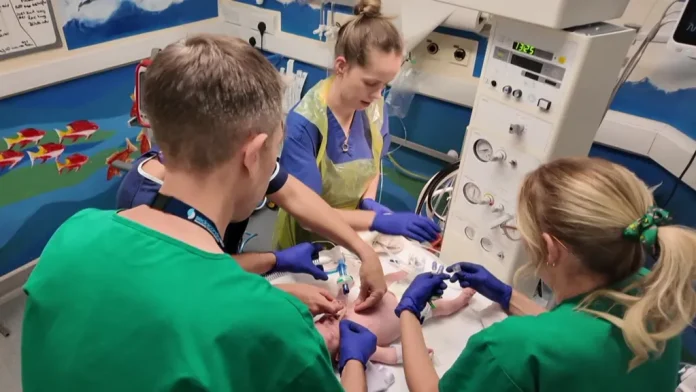
Paediatric Retrieval Teams play a vital role in saving the lives of critically ill children across the United Kingdom. These specialised medical teams transport the most seriously ill babies and children between hospitals so they can receive advanced treatment in paediatric intensive care units. However, rising demand during the winter months is placing increasing pressure on these lifesaving services.
During a recent emergency, ten-week-old Carson required urgent help after developing severe breathing difficulties. Carson was born prematurely at the Royal Hampshire County Hospital in Winchester and his lungs remained fragile. Doctors suspected he had developed an infection that his small lungs could not handle.
Medical staff managed to stabilise him initially. Nevertheless, Carson needed specialist care beyond what the hospital could provide. As a result, doctors contacted the Paediatric Retrieval Teams that operate across the south of England.
These specialist teams respond around the clock to emergencies involving critically ill children. One such service is the Southampton Oxford Retrieval Team, commonly known as SORT. The team supports 27 hospitals across southern England and operates 24 hours a day.
When the call about Carson arrived, the SORT team quickly prepared to travel to Winchester. Their mission was to stabilise the infant and transport him safely to a hospital with a paediatric intensive care unit.
However, there was a serious challenge. At that moment, no beds were available in the paediatric intensive care unit in Southampton. Despite the lack of available space, the Paediatric Retrieval Teams still responded to the emergency.
Michael Griksaitis, a consultant paediatric intensivist at University Hospital Southampton, leads the team. According to him, the team always responds to emergencies regardless of bed availability.
He explained that critically ill children still require immediate care. Therefore, the transport team must reach them as quickly as possible. Whether a hospital bed is available or not, the team provides critical support to stabilise the child.
Winter months often create particularly intense pressure for Paediatric Retrieval Teams. Respiratory infections and seasonal illnesses increase the number of critically ill children requiring intensive care. Consequently, retrieval teams often receive multiple emergency calls each day.
SORT alone frequently responds to three emergency transfers daily during winter. These missions involve travelling to hospitals that lack paediatric intensive care units and transporting children to specialised facilities.
Most hospitals in the UK do not operate a paediatric intensive care unit. Therefore, retrieval teams bridge the gap between smaller hospitals and advanced care centres. Without these services, many critically ill children would struggle to access the treatment they urgently need.
Despite their critical role, new pressures are emerging for Paediatric Retrieval Teams across the UK. The BBC has reported that retrieval services may soon be asked to transport significantly more children who are less critically ill.
These patients fall into what clinicians describe as Level 2 care. Level 2 patients still require specialised monitoring in high-dependency hospital beds. However, they do not necessarily require full intensive care treatment.
Under new expectations, retrieval teams could transport hundreds more of these patients each year. However, the challenge is that these additional responsibilities come without extra funding or resources.
All thirteen retrieval teams across the United Kingdom already operate at full capacity. Nevertheless, they may soon be expected to expand their workload to meet rising healthcare demand.
According to Griksaitis, the current system was never designed to support this extra level of activity. Transport teams already move critically ill children between hospitals every day. Therefore, adding more patients without additional resources could stretch services even further.
Healthcare professionals warn that such pressures could make operations increasingly difficult. Retrieval teams may have to travel longer distances or complete more transfers within a single shift.
To manage the additional demand, SORT estimates it would require another ambulance and additional specialist staff. The estimated cost of this expansion would be around £2 million for each team across the UK.
Without such investment, staff fear that the pressure could become overwhelming. Griksaitis admits that the growing demand keeps him awake at night. He worries about the strain that future expectations could place on the service.
Despite these challenges, Paediatric Retrieval Teams continue to prioritise the sickest children. NHS officials say critically ill patients always receive priority when resources are limited.
An NHS spokesperson confirmed that paediatric transport teams provide high-quality clinical care during inter-hospital transfers. The NHS also said it will closely monitor transport demand to ensure services remain safe and effective.
Meanwhile, Carson’s case highlights how essential these teams remain. After arriving in Winchester, the SORT team stabilised the baby and prepared him for transfer.
Fortunately, a bed became available at the paediatric intensive care unit in University Hospital Southampton. The team then transported Carson safely to the hospital.
The journey took about two hours. Once Carson arrived, doctors performed several medical tests to determine the cause of his breathing problems.
Specialists eventually confirmed that Carson had bronchiolitis, a common viral infection that affects the lungs of infants. Although the illness can become serious in premature babies, early treatment in intensive care often leads to recovery.
Carson spent a short period in the paediatric intensive care unit while doctors monitored his condition. Thanks to the rapid response from the retrieval team and hospital staff, he recovered quickly.
Soon afterwards, Carson returned home with his family.
His story demonstrates the lifesaving work of Paediatric Retrieval Teams across the UK. These specialist teams ensure that critically ill children receive expert care even when they are far from major hospitals.
However, rising healthcare demand means these teams may face increasing pressure in the years ahead. Without additional funding and resources, the services that save vulnerable children may struggle to keep pace with the growing need for critical care transport.

