
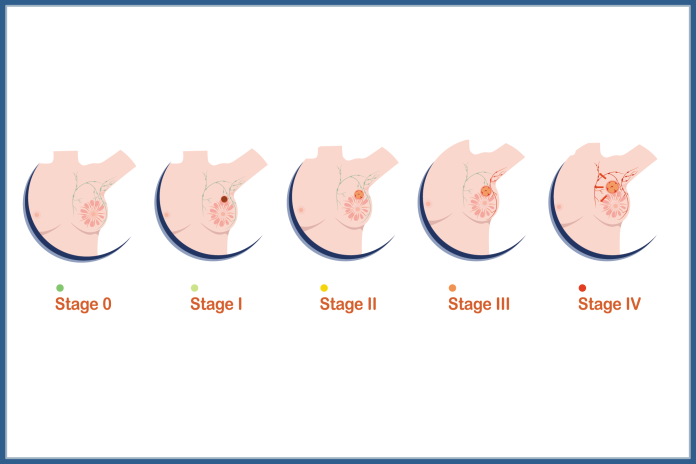
After receiving a breast cancer diagnosis, understanding the stages and grades of breast cancer is crucial in determining treatment options and predicting your outlook. Doctors use these factors to evaluate the extent of the disease and guide the treatment plan. In this article, we break down the different stages and grades of breast cancer, the symptoms to watch out for, and how these elements influence your treatment and prognosis.
What Are Stages and Grades of Breast Cancer?
Both staging and grading are essential tools doctors use to describe breast cancer. Staging indicates the size of the tumor, its spread to nearby lymph nodes, and whether it has spread to other parts of the body. Grading refers to how abnormal the cancer cells appear compared to normal cells and helps predict how fast the cancer may grow.
How Doctors Determine Breast Cancer Staging
Doctors use a combination of tests, including imaging and biopsy, to determine the stages and grades of breast cancer. The American Joint Committee on Cancer developed the most common staging system, called the TNM system:
- T: Size of the tumor
- N: Whether the cancer has spread to nearby lymph nodes
- M: Whether cancer has spread to distant parts of the body
This system evaluates these factors to assign a stage. Other important elements, like hormone receptor status and HER2 status, are also incorporated into breast cancer staging.
Understanding the Five Stages of Breast Cancer
Stage 0: Carcinoma in Situ
Stage 0 is the earliest form of breast cancer. Cancer cells are confined to the ducts or lobules and have not spread to nearby tissue. This stage usually has an excellent prognosis.
Stage 1: Early Invasive Cancer
Stage 1 is characterized by small tumors (less than 2 cm) that haven’t spread to nearby lymph nodes. It is further divided into 1A and 1B:
- Stage 1A: Tumor no larger than 2 cm with no spread outside the breast.
- Stage 1B: Small tumor or no detectable tumor, but small groups of cancer cells are found in nearby lymph nodes.
Stage 2: Larger Tumors or Spread to Lymph Nodes
Stage 2 cancers are larger or have spread to lymph nodes near the breast. It’s broken down into 2A and 2B:
- Stage 2A: The tumor may be smaller than 2 cm, and cancer has spread to up to three lymph nodes near the breast.
- Stage 2B: Tumors range from 2 to 5 cm, with possible spread to up to three lymph nodes.
Stage 3: Locally Advanced Cancer
Stage 3 cancers have spread beyond the breast to nearby tissues or lymph nodes. It is divided into 3A, 3B, and 3C:
- Stage 3A: No detectable tumor or a tumor larger than 5 cm, with cancer spreading to up to nine lymph nodes.
- Stage 3B: Tumor of any size, spread to the chest wall or skin, and up to nine lymph nodes affected.
- Stage 3C: Cancer has spread to more than 10 lymph nodes, the chest wall, and the skin.
Stage 4: Metastatic Cancer
Stage 4 breast cancer, or metastatic cancer, occurs when cancer has spread to distant organs such as the bones, lungs, liver, or brain. This is the most advanced stage of breast cancer and requires more aggressive treatment.
Breast Cancer Grade: What Does It Mean?
Grading is an additional method used to evaluate breast cancer. It describes how different the cancer cells are from normal breast cells. The grade indicates how likely the cancer is to grow and spread:
- Grade 1 (Low grade): Cells look similar to normal cells and grow slowly.
- Grade 2 (Moderate grade): Cells look less like normal cells and grow more quickly.
- Grade 3 (High grade): Cells look very abnormal and grow quickly.
Outlook and Prognosis Based on Stages and Grades of Breast Cancer
The stages and grades of breast cancer heavily influence the prognosis and treatment plan. Early-stage cancers (Stages 0 and 1) generally have a good prognosis with high survival rates, while later-stage cancers (Stages 3 and 4) are more challenging to treat. The grade of the cancer also plays a role, as high-grade cancers tend to grow more aggressively.
What Are the Factors That Affect Breast Cancer Outlook?
Several factors can impact the prognosis, including:
- The stage of the cancer
- The grade of the cancer
- Hormone receptor status and HER2 status
- Overall health and response to treatment
- Age at diagnosis
Conclusion: Importance of Early Detection and Staging
Understanding the stages and grades of breast cancer is crucial for both patients and healthcare providers. Early detection and accurate staging lead to more effective treatment and better outcomes. Regular screenings and consultations with your healthcare team can significantly improve your chances of recovery and help manage the disease effectively.

